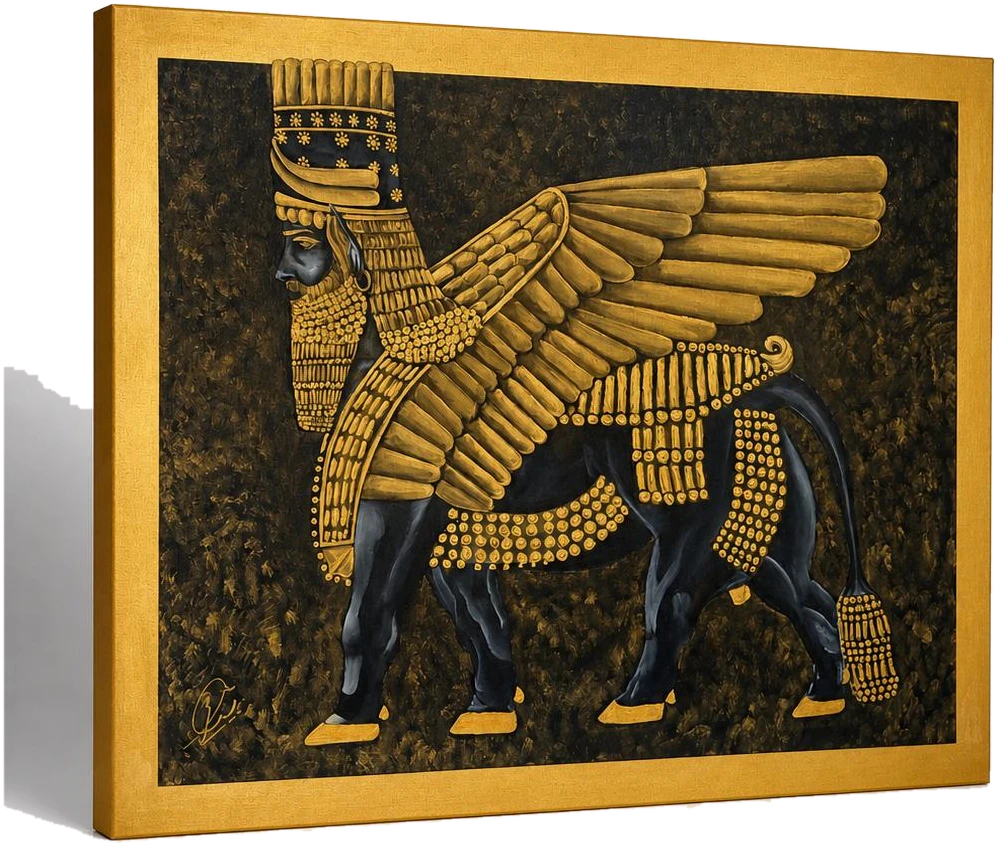
Lamassu
Iran, the cradle of world civilisation.
- Medium
- Acrylic on canvas
- Code
- 29
This painting draws on the bas-relief of the Lamassu — the Winged Bull of Persepolis, in Iran — dating from around 518 BC, which remains an extraordinary testament to the splendour of the Achaemenid Empire.
That colossal sculpture, raised by order of Darius the Great, bears a human head, the body of a lion and the wings of an eagle. Its role was to repel evil and to protect important places such as palaces and cities, its monumental figures being set at their entrances.
The Winged Bulls of Mesopotamia are a combination of four creatures visible across many ancient carvings, having become the symbols of four Babylonian beings: they possess the body and tail of a bull, the head of a human, and wings resembling those of an eagle.
These creatures also represent the four cardinal points and the four fundamental elements.
Salute to the light